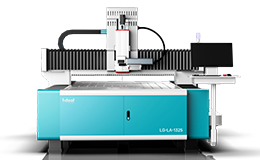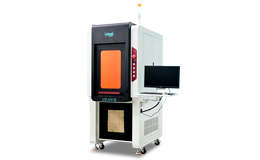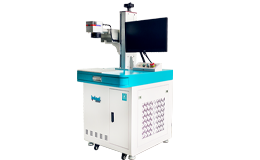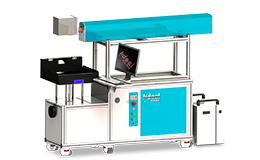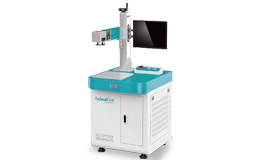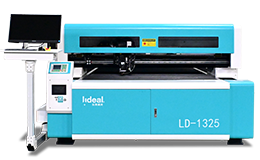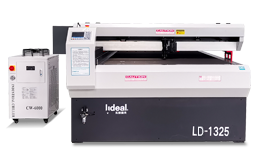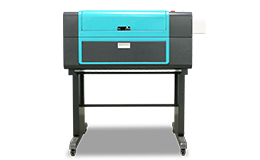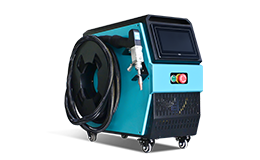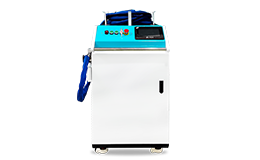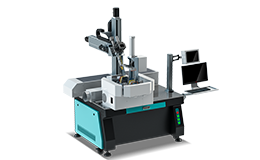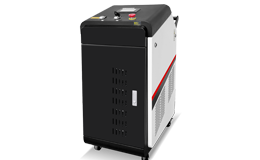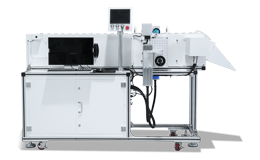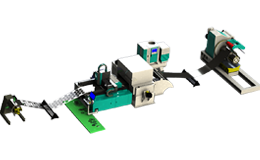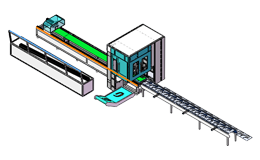

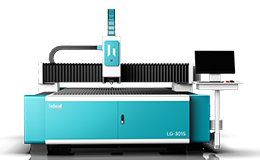
LD-1325
Q&A
Product issue
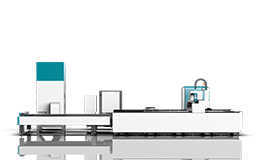
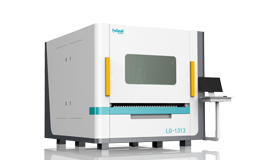
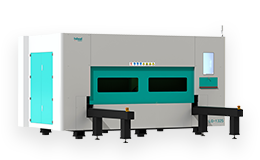
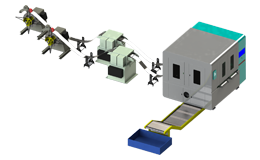
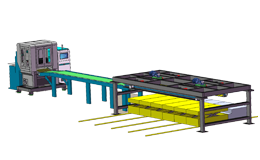
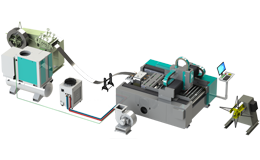
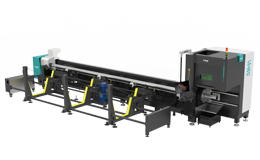
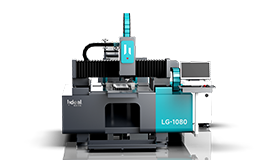
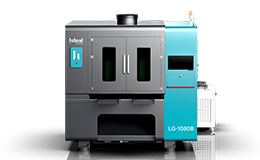
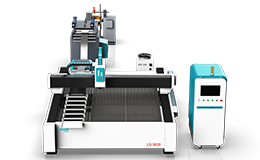
What are the features and advantages of the Ledi 1080 series products?
The Ledi 1080 series products have the following features:
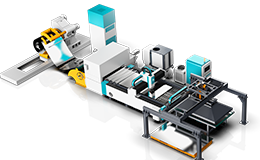
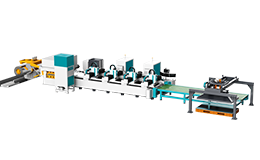
1. Automation solutions.
Upgraded from a single cutting line to a one-stop processing production line, one machine can handle multiple procedures, materials are taken as needed to eliminate waste, no molds are required for simplicity and speed, and automatic palletizing and material cutting are more organized.
2. Precise feeding and precise cutting
Rolling and leveling + precise fixed-length feeding, the feeding accuracy can reach ≤0.5mm. The repeat positioning accuracy for cutting is 0.02mm, and the cutting acceleration is 1G.
3. High-strength bed & crossbeam
The structure of the gantry-type frame machine tool is characterized by its overall welded rigidity, stability and high precision. Aerospace aluminum crossbeams are corrosion-resistant and anti-oxidation.
4. High power and high precision
It adopts fiber lasers, intelligent cutting heads and high-precision displacement modules to achieve stable cutting performance with high speed and high precision.
5. Bus control system
The page is user-friendly and the operation is convenient. By importing processing drawings, products of different requirements can be produced, meeting the operation demands of various shapes and diverse production processes.
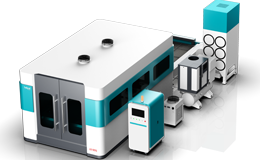
6. Non-standard customized full protection work
According to the workpiece to be cut and the working environment, the following can be optionally equipped: fully enclosed design structure, dust removal and purification device, winding and palletizing.
General problem
In the field of metal processing, how to select a fiber laser cutting machine with appropriate power based on material thickness and processing efficiency requirements?
The power selection of a fiber laser cutting machine needs to comprehensively consider the material thickness and processing efficiency. Generally, a 2kW device can cut carbon steel of 6mm or less, with an efficiency of up to 8m/min. The 4kW equipment is suitable for 10mm plates, and the cutting speed is increased by 30%. For high-power models above 6kW, they can handle plates as thick as 20mm. Combined with intelligent perforation technology, the preheating time can be reduced.
What are the main differences and applicable scenarios between CO₂ laser cutting machines and fiber laser cutting machines when processing non-metallic materials?
CO₂ laser (10.6μm) has a high absorption rate for non-metallic materials such as acrylic and wood, with smooth cutting edges free of burrs, making it suitable for the advertising signage and packaging industries. The metal absorption rate of fiber laser (1064nm) is 35%, but the non-metal absorption rate is only about 5%, and it is prone to carbonization.
When yellow edges occur during the cutting of stainless steel, how can the problem be solved by adjusting the process parameters?
The yellow edge of stainless steel is mainly caused by the deposition of oxide layers and requires nitrogen-assisted cutting. Suggested parameter adjustments: Increase the power density to 0.8kW/cm², reduce the cutting speed by 10%, and increase the nitrogen pressure to 1.5bar.
In the welding of battery tabs for power batteries, how to solve the problems of hot cracks and pores in aluminum materials?
Aluminum material welding requires the use of high-frequency pulse modulation technology, with the frequency set at 200-500Hz and the duty cycle at 30%-50%. The annular spot welding head can form a molten pool with high energy density at the center and a preheating zone on the periphery, effectively reducing stress concentration. In conjunction with the online quality monitoring system, the weld penetration depth and porosity can be detected in real time, increasing the welding yield from 85% to 99.2%.
When connecting dissimilar metals (such as copper-aluminum), how can the formation of brittle compounds be avoided?
Dual-wavelength composite welding technology should be adopted. First, a 1064nm fiber laser is used to preheat the copper material, and then it is switched to a 532nm green laser to complete the fusion of the aluminum material.
Which materials are suitable for laser welding?
It is suitable for thin-walled metals (such as stainless steel, aluminum, copper, titanium, etc.), and can achieve precise spot welding and lap welding. It is especially suitable for the connection of dissimilar materials (such as copper-aluminum)
Pre-sale issues
When marking QR codes on electronic components, how can the recognition rate of 0.1mm modules be guaranteed?
It adopts ultraviolet laser (355nm) combined with ultra-fine spot technology, with a spot diameter of no more than 10μm. The AI algorithm developed by our company can optimize the scanning path in real time and compensate for positional deviations of 0.05mm. According to tests by authoritative institutions, the recognition rate of the 0.1mm module QR code at a resolution of 5mil reaches 99.9%, meeting the GS1 standard and passing the dynamic scanning test at a speed of 10 meters per second.
When marking plastic products, how to distinguish the process parameters of different materials (ABS/PC/PVC)?
ABS requires the use of an 800nm near-infrared laser with an energy density of 12J/cm² and a speed of 800mm/s. PC is suitable for 1064nm fiber laser, with an energy density of 8J/cm² and a speed of 1200mm/s. PVC must use a CO₂ laser with a power of 15W and a speed of 600mm/s.
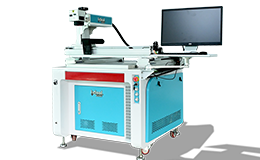
When choosing a laser engraving machine, which wavelength of laser should be selected for different materials?
Metal (450nm/1064nm), glass (1064nm), leather (450nm), jade (UV 355nm), acrylic (450nm)
After-sales issues
In the maintenance of laser equipment, how can the service life of core components (such as lasers and galvanometers) be prolonged?
Daily cleaning adopts an automatic dust removal system with a filtration efficiency of 99.5%. Monthly inspections include optical path calibration (accuracy ±0.01mm) and cooling system testing. Annual maintenance includes cleaning of the laser cavity and dynamic testing of the galvanometer. Through this system, the lifespan of fiber lasers has been extended to 100,000 hours, the failure rate of galvanometers has been reduced by 80%, and maintenance costs have been saved by 40%.
What's the after-sales service phone number?
Ledi Laser Technology Co., LTD. After-sales service Hotline: 0539-8322880
Hello
top
Online Message
Your information will be strictly confidential. Please fill it out with confidence.
Send